

School buses and public transit buses are major producers of air pollution. According to the EPA, exposure to pollution from transportation especially effects school children by reducing their lung function which increases rates of pneumonia and asthma, leading to over 100 million annually in health expenditures for American families. To reduce these harmful emissions, the EPA created programs to transition bus fleets to use cleaner alternative fuels. The Environmental Protection Agency implemented a Clean School Bus Program across the nation to reduce air pollution and improve health. This program earmarks $5 billion in funding through fiscal year 2026 to replace fleets with low and no emissions models. The deadline for this program was January 14th, 2025. Open to both schools and transportation services; Those that qualify could receive up to $345,000 to purchase a bus and charging station in exchange for an older higher emissions producing bus, up to 25 buses. Priority is given to rural, tribal, and high-need school districts. School districts on the priority list qualify for the full $345,000 rebate for each diesel bus they replace. Stay up to date on the Clean School Bus Program by signing up for updates.
The U.S. Department of Transportation’s Federal Transit Administration also offered $1.5 billion in grants through the Buses and Bus Facilities Program to replace, rehabilitate, and purchase buses, vans, and related equipment, and to construct associated bus facilities, including low or zero emission vehicles or facilities. Funding could also have been requested for workforce development training. The Wisconsin Department of Administration (DOA) also offers grants for the replacement of eligible public transit buses. Many incentives are also available through local utility companies.
Wisconsin Clean Cities helps schools districts (including state and local government programs, federally recognized Indian tribes, non-profit organizations, and transit contractors) navigate this landscape of fund procurement. We also help discern what technologies will best meet an organization’s needs considering local weather, route characteristics, budget, and withstanding infrastructure. We provide technical assistance and training through out the transition, and help obtain the infrastructure required to support the new alternative fuel/technology. Part of this mission entails holding in-person events where WCC demonstrates alternative fuel buses, allowing for up close inspections, and answering questions. These events are open to the public, attracting curious parents, education, transportation, and energy professionals who work in tandem to complete transitions.
Our last bus event was October 25th 2024 in Mondovi.
Funding Opportunities:
1 billion in rebates are available to replace existing school buses with clean and zero-emission models. Schools interested need to apply before January 14th 2025. They will need to create a Sam.gov account and fill out the rebate application. The EPA will notify them in May of 2025 if they were accepted. Upon notification you will be given until November 2025 to submit a purchase order & request payment. After the payment is made, the buses will be delivered.
Who can apply:
-
-
Public school districts and other state or local government entities that are responsible for providing school bus service to at least one public school system and/or the purchase, lease, license, or contract for service of school buses
-
Public charter school district responsible for the above
-
Tribal applicant responsible for the above
-
Nonprofit school transportation association or eligible contractor
-
Essential community facilities in rural areas (cities, villages, townships or towns) with less than 20,000 residents can apply, or low income communities which have a media household income below 80% of the state median, can apply for additional grants and low interest loans.
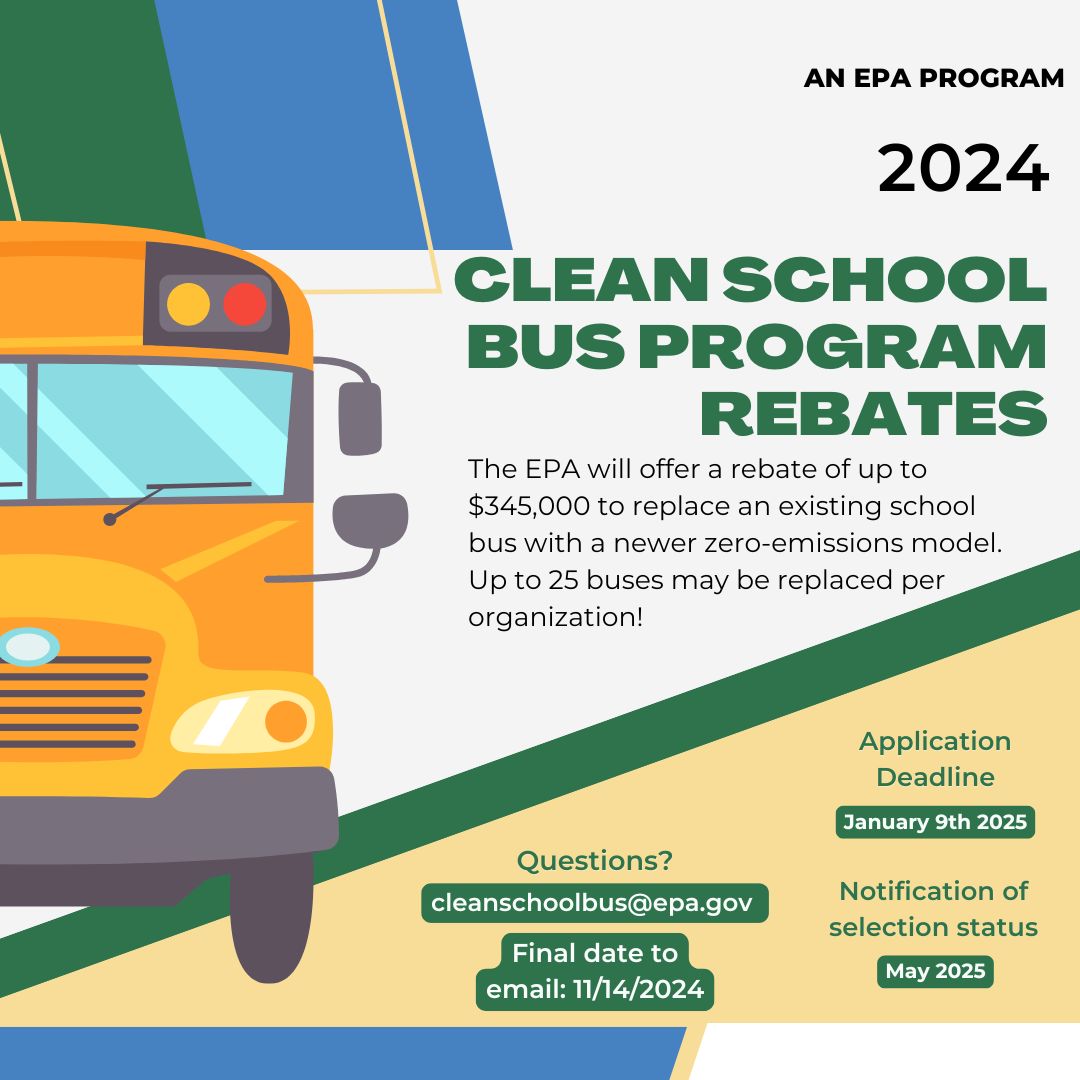
Key details for the EPA Clean School Bus Program (Rebates) 2024-2025:
- Funding Cap per Bus: Up to $325,000 per bus and infrastructure (charging stations, panels, workforce training, etc.) for priority applicants; $170,000 for non-priority applicants
- Bonus: Up to $20,000 added for ADA-compliant wheelchair lift equipped buses
- New This Round: Apply for up to 50 buses
- Funding provided upfront, after proof of purchase order
- Application process: simple and easy and closes on January 9, 2025
- Selection Process: Winners chosen via a randomized lottery with awards announced May 2025
- Additionally, the EPA is hosting webinars on the program and NREL is offering FREE expert assistance for potential applicants and rebate winners
More Funding Opportunities:
The alternative Fuel Vehicle Refueling Property Tax Credit offers up to 30% (or up to $100,000) back in tax credits for installation of alternative fuel supporting infrastructure. Even for tax exempt entities! How? Enroll in the “direct pay option” which allows for the nonprofit organization, municipality, school, church or charity to pass the credit to the dealer who then offsets the cost up front.
Electric Vehicle (EV) and Fuel Cell Electric Vehicle (FCEV) Tax Credit The federal government also provides a tax credit for the purchase of a used ($4000), or new ($7500) all electric of plug-in hybrid electric vehicle. Busses or heavy duty vehicles over 14,000 lbs may receive up to $40,000. Tax exempt entities such as municipal fleets, nonprofits, tribes & schools) can transfer the credit to the dealer in exchange for either cash or a partial payment or down payment for the purchase of the vehicle.
River Falls & New Richmond surrounding districts can receive up to $5000 in rebates for a level 3 charger installation (each year 1 new charger can be rebated).
Madison Gas & electric have a charging incentive program that schools may qualify for, they may also qualify for free level 2 chargers. MGE also offers to own and maintain chargers at fleet vehicle garages for a monthly fee.
Wisconsin Propane Gas Association rebates $3,500 per propane vehicle, up to ten vehicles. A survey is done upon the initial transition asking why the transition is being done, why propane was chosen, etc. 6 months later a survey issued for each vehicle asking about what maintenance has been done and how the vehicle is performing. Upon completion of these surveys – rebate checks are issued. This incentive program ends December 31, 2024 or until the funds exhaust. The Propane gas council also gives up to $17,500 to help implement propane education curriculum into schools.
Pierce Pepin Coop has a Rebate charger program which rebates $800 towards every charger installed.
Sun Prairie will consider rebates between $250 – $1500 per charger depending upon the level of charger.
DTE Electric Company has started a program in late 2023 that offers over $18 million to provide education & outreach, along with rebates up to $5000 for installation of approved chargers. They began a new pilot School Bus Charger program that will fund the installation and pay for the cost of a V2G charger for owners of school buses looking to electrify.
Allette, Inc. provides rebates on purchases and installations for approved chargers & special rate programs.
Xcel Energy has a fleet electrification advisory program that it offers to any organization ready to develop an electrification plan for their fleets. They also host a Shared Parking EV Service Infrastructure Program that will install, own and maintain EV supply Infrastructure and charging equipment that the site host selects from a Company-approved list for a fixed monthly rate.
Bayfield Electric Cooperative & Scenic Rivers Energy Cooperative may consider up to $800 in rebates for an installed charger
Relevant information:
Step by step guide to the electrification process for a school fleet.
A collection of resources for schools contemplating electrifying their school fleet.
Any further updates will be added to our membership section.


You must be logged in to post a comment.